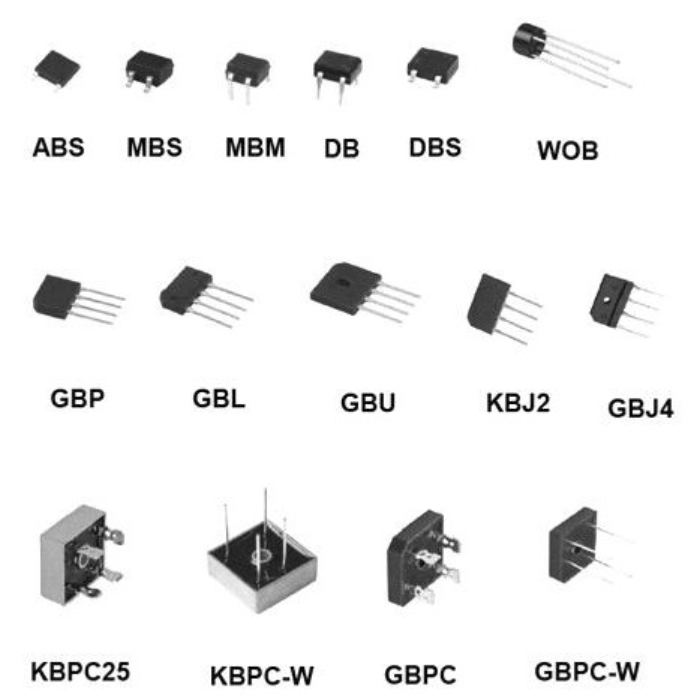
A bridge rectifier is an electronic circuit with four or more diodes arranged in a bridge configuration to convert alternating current (AC) into direct current (DC) through full-wave rectification. It effectively utilizes both the positive and negative halves of the AC signal, redirecting them so that the output current always flows in the same direction, providing a more efficient and consistent DC voltage than a half-wave rectifier.
Applications:
- Power Supplies (PSUs): The core component in AC-to-DC power adapters for nearly all electronic devices, converting wall power for devices like laptops, TVs, and routers.
- Battery Chargers: Convert AC from the mains into the DC required to charge batteries in cars, forklifts, and backup systems.
- Industrial Equipment: Used in motor controllers, welding machines, and HVAC systems to provide steady DC power for operation.
- Renewable Energy: Essential for solar inverters and wind turbine systems to convert variable AC into usable DC for storage or grid connection.
- Household Appliances: Found in microwaves, washing machines, and other devices to power their internal DC circuits.
Specialized & Niche Uses:
- Signal Processing: Used for demodulating radio signals in older radios and TVs.
- Reverse Polarity Protection: Can protect DC circuits by making the input polarity irrelevant.
- Frequency Doublers: Can be configured as simple frequency doublers in some circuits.